
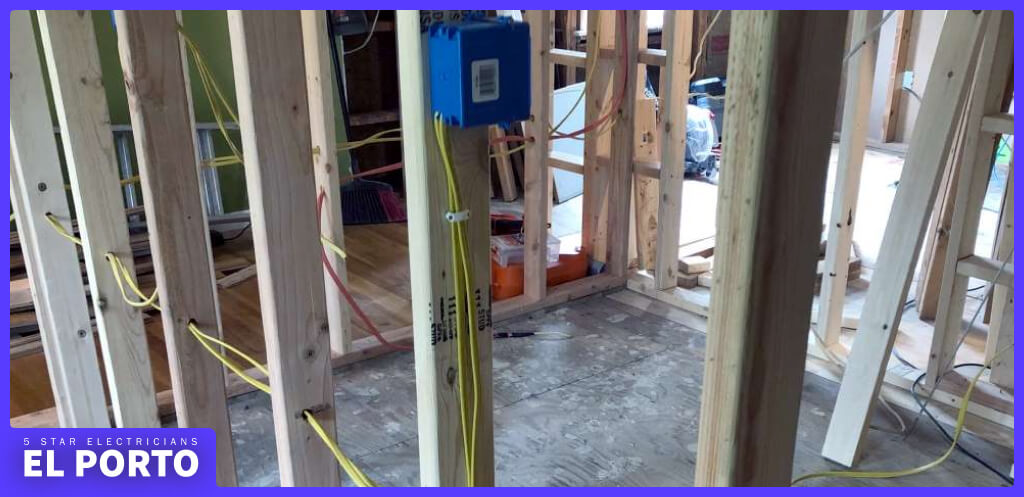
Expert electrical house rewiring in El Porto for your house may be required for various factors. The most evident instance is when you buy a brand-new house. New residences require wiring from all over the households. The expense of cabling a brand-new home is sometimes integrated into the overall buying price of the house.
When you own an older house that cannot accommodate contemporary technologies, you might require it to be rewired by an expert like 5 Star Electricians El Porto. The expense of rewiring a house is determined by the job that has to be performed and other criteria, such as the size of your property.
Whether you’re curious about how expensive to rewire a property, we’ve put up this pricing guide to assist you. You’ll learn about the estimated price of wiring replacement for your household, the most prevalent sorts of rewiring projects, and the approximate amount they normally cost.
What Would a House Rewiring Work Typical Cost?
According to industry standards for calculating home improvement works, the typical cost to upgrade electrical cabling in a household varies from $2,000 to $9,000. The price range is determined by factors such as expert hourly rates, the scale of your property, the convenience of accessing the wires that need to be changed, and the expense of additional supplies. The list below shows the typical cost of rewiring a residence and several high and low amounts.
• Low Cost – $125 (for minor tasks such as replacing wall plugs)
• Average Cost – $2,115
• High Cost – $11,400
Cost of Rewiring a Home Per Square Foot
Numerous electricians will give you a price per square foot to rewire your home. As a result, it’s useful to know if your quoted cost is comparable to the national median. The estimated price of rewiring a home is somewhere around $2 and $4 per square foot.
Do you want to know how long it will take to complete the task? It’s critical to understand whenever you’re hiring an electrician by the hour. Rewiring operations are typically paid at one hour for every 100 square feet.
Here is a brief look of the per-square-foot cost of rewiring a home:
| SQUARE FEET | AVERAGE COST |
| 1,000 1,200 1,500 2,000 2,500 3,000 | $1,650 – $3,800 $2,000 – $4,500 $2,350 – $5,700 $3,200 – $7,700 $3,900 – $9,500 $4,800 – $11,500 |
The Expense of Rewiring a Household Per Material
Whenever it pertains to the expense of rewiring a home, the cables and wires will also impact it. Based on your specific requirements, your specialist may propose one of the cables below.
• UF Cable – Wiring using UF (Underground Feeder) cables will cost between $0.50 and $0.75 per linear foot.
• THHN/THWN Wire – THHN (Thermoplastic High-Heat resistant Nylon-coated) and THWN (Thermoplastic Heat and Water-resistant Nylon-coated) each priced between $0.80 and $1.60 per linear foot to rewire.
• NM Cable – Rewiring NM (Nonmetallic) wires costs between $0.40 and $0.80 per linear foot.
With these considerations in mind, we hope that everyone can understand the true cost of rewiring a home and that it answers everybody’s questions about rewiring a household.
When is the Best Time to Change the Wiring in the Household?
Based on the National Fire Protection Association, over 45000 households in the United States report fires caused by electrical faults. It is critical to safeguard your residence from such fire hazards, which are frequently avoidable, by being careful and performing routine electrical inspections by an electrician like 5 Star Electricians in El Porto where necessary.
An electric wire’s life expectancy is 50-70 years under optimum conditions. However, you may need to update the electrical wiring sooner. Wire deterioration and wear can occur early owing to environmental variables or poor wiring.
Changing your home’s aging electrical cabling is critical at the first hint of trouble. If your home is old, this danger rises; therefore, getting the old or broken wiring changed with a wiring replacement job is better.
Does a Homeowner’s Insurance Cover Rewiring?
Domestic electrical wiring is often included under a homeowner’s insurance coverage for electrical fixes and damages. Conversely, older properties with antiquated wirings, such as aluminum wire or knob and tube, are more inclined to be harder to cover and could be more expensive to insure. The increased cost of homeowner’s insurance in such circumstances is due to the greatly increased fire threat that such outdated wiring presents.
Before purchasing, living in, or insuring an older house, have it evaluated by a certified electrician to ensure that all cabling is in excellent working order. With updated wiring, a homeowner’s insurance underwriter might charge a lower cost for the policy. Obsolete cabling needs an increase in rate to meet the provider’s increased risk in covering property with significant electrical dangers.
Therefore, if you have upgraded the cabling in your house, notify your insurance carrier and inquire whether you are eligible for a new-wiring credit or a different reduction in your premium rate.
Do Electricians Plaster After a Rewire Work?
After rewiring, many electricians do not use plaster. Plastering is a specialized skill set that pros make appear far simpler than it is. We observe plasterers skimming effortlessly (like our technicians here at 5 Star Electricians in El Porto) and believe we can do so. The fact is that plastering over the brand-new wires hidden in the wall is a difficult process to do.
Plastering the chases is straightforward, but ensuring that the finish seems smooth and level is a different story. It is sometimes preferable to have a room fully re-plastered following a rewiring work so that the walls have a consistent finish and do not exhibit the marks of the chases or the wiring replacement job.
Can You Leave Old Wires in the Wall?
The National Electrical Code makes no mention of decommissioning discarded electrical wires. If it is a radio, communication, television, or another cable, you need to remove the accessible piece of the cable. It must be removed if the wire is in a raceway (cables trays, conduit, etc.).
However, with time, pieces of it may become broken or degrade, posing a major fire or shock threat. Nevertheless, age alone does not imply that wire is intrinsically harmful, nor does it necessitate the replacement of old cabling.
Since old cabling is frequently stapled to the structure, homeowners can’t just rip the wires from the wall. After ensuring that the electricity is turned off, the electricians may sever the wire and pull out the visible portion, leaving the concealed part of the cable within the wall.
How do I Make Old Wiring Safe?
If you want to make your old wires safe, the best way to do so is by replacing them with modern ones by employing our 5 Star Electricians in El Porto. Old wires, especially those that use aluminum wire, are very prone to fire hazards, and one should take serious precautions against them.
But if you cannot get wiring replacement work done right away, electrical tape is the most basic means of protecting electric cables. As an added precaution, you apply tape on sealed live electric lines. Tape can be utilized to secure loose live wires that cannot fit within the cap. To fit inside the cap, wrap the tape around the cable.
Having electrical difficulties might be difficult, but you do have us. Keep on reading since we will gladly supply additional blogs or articles on connected electrical topics. You can also phone us if you need assistance regarding your electrical issues.